Five sisters, one needle box, and the colours of Gujarat
We are five sisters. We grew up in a house where colour was never optional — where Ba's bandhani odhni dried on the terrace line, where every Diwali began by hanging the toran, and where the sound of a wedding was the jingle of coins stitched onto a ghagra fifty years ago.
Bawariyo began at our dining table with one potli, stitched as a gift. Then another. Then a dozen more, as friends kept asking, "where did you find this?" The answer was never a shop — it was us: five pairs of hands, each with her own instinct. One of us always reached for the antique gold coins. One could not resist gulaal pink. One loved the flash of desert mirrors, one the depth of midnight silk, one the patience of pearl edging.
So instead of fighting over whose taste would define the label, we let all five win. Those five instincts became our five styles — રાણી Rani, ગુલાલ Gulaal, કેસર Kesar, નજર Nazar and બંધન Bandhan. Every piece we make belongs to one of them, carries its pattern — and is still made only once.
What began as word-of-mouth orders among friends and family is now our small promise to Gujarat's craft: every piece made once, made whole, made by hand.
— The five sisters of Bawariyo, ગુજરાત ના રંગો સાથે (with the colours of Gujarat)
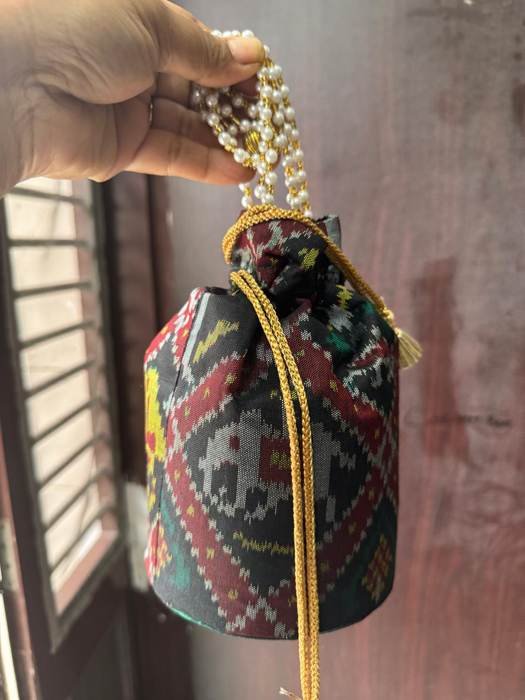
Because that is honestly how we work. A style is a sister's signature: her pattern, her palette, her trims. When you carry a Rani, you carry her love of heirloom coins; when you carry a Bandhan, you carry another sister's patience with pearls.
The style gives you something to recognise and collect. The handwork guarantees your piece is still the only one in the world.
The geometric, flame-edged patterns on our bags are woven into the silk itself — not printed on it. Patola weaving is one of Gujarat's oldest textile arts, so prized that the old Gujarati song promises "છેલાજી રે, મારે હાટુ પાટણથી પટોળાં મોંઘાં લાવજો" — bring me the precious patola from Patan. We work with genuine patola and ikat-weave silks so the pattern lives inside the cloth.
The cascades of antique-gold discs on our Rani and Nazar pieces echo the coin embroidery of Gujarat's pastoral and nomadic communities, whose women stitched their family's wealth into their clothes — treasure you could wear, history you could hear. Each coin is applied by hand, one at a time.
Small mirrors stitched into cloth to catch Gujarat's desert light — and, as tradition says, to flash away the evil eye. Our Kesar pieces use hand-set abhla in classic Gujarati arrangements.
The joyful finishing touches of Gujarati craft: pearl (moti) edging on our Bandhan pieces, silk tassels, leheriya-bright pom-poms and brass ghungroo bells — the same trims that dance on torans, camel decorations and garba ghagras across Gujarat.
The best way to know the craft is to hold it.
View the Five Styles Say Hello on WhatsApp